

This guide helps you understand the price of an ecological study, plan the budget and compare quotes that, at first glance, look nothing alike.
The short answer
An ecological study generally costs €1,500 to €5,000 excl. VAT for a preliminary assessment, €4,000 to €12,000 excl. VAT for a simplified assessment and €15,000 to €50,000 excl. VAT or more for a full assessment over a biological cycle (“four-season” surveys).
The price depends mainly on the number of days in the field, which follows from the area, the diversity of habitats, the species groups to survey and the number of visits required. To compare two quotes, compare field days and groups covered, not just the final amount.
At a glance
A study is billed mainly in expert days: fieldwork, analysis, mapping, reporting.
Fieldwork often accounts for half the budget or more in a full assessment.
Night surveys (bats, amphibians) and equipment (recorders, camera traps) weigh on the quote.
A low quote with few visits risks a request for additional information from the authorities, meaning extra cost and delay.
The amounts in this guide are orders of magnitude: only comparing quotes sets a firm budget.
Price ranges by type of study
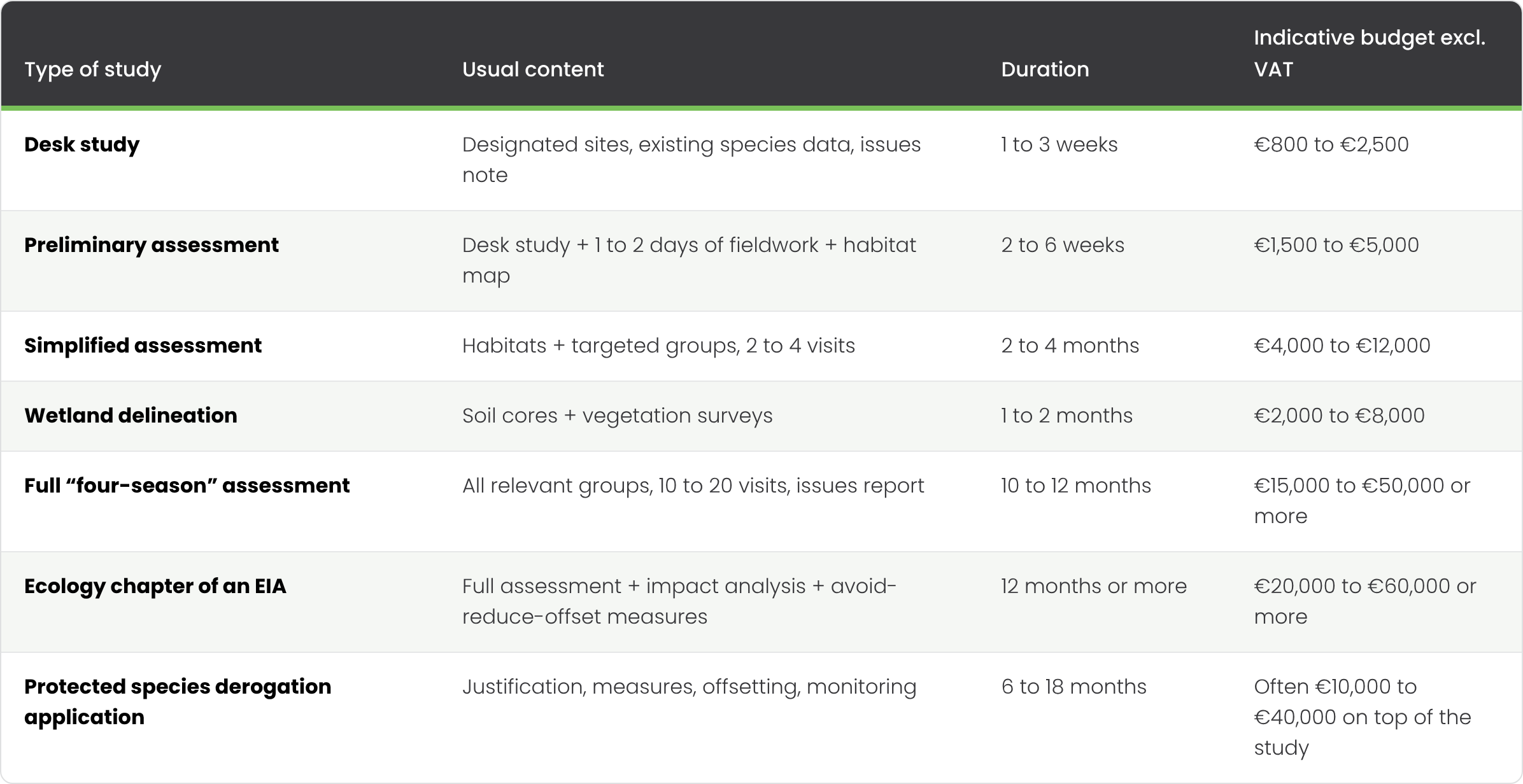
Ranges observed for sites of a few hectares in mainland France. They do not include the cost of the offsetting measures themselves.
The 8 factors that drive the quote
Site area and diversity: 10 hectares of uniform farmland take less time than 3 hectares mixing woodland, meadow, pond and buildings.
Species groups to survey: plants and habitats, birds, amphibians, reptiles, insects, bats, mammals. Each group adds dedicated visits.
Number of visits and seasons covered: a full biological cycle means visits from early spring to autumn, sometimes in winter too.
Night surveys: bats and amphibians require night visits, often charged at a higher rate.
Equipment: acoustic recorders left out for several nights, camera traps, environmental DNA analysis where relevant.
Regulatory context: an EIA or derogation application requires more analysis, justification and mapping.
Deliverables: report, GIS mapping, georeferenced data, feedback meetings, exchanges with the authorities.
Travel: a distant consultancy charges travel and accommodation for each visit.
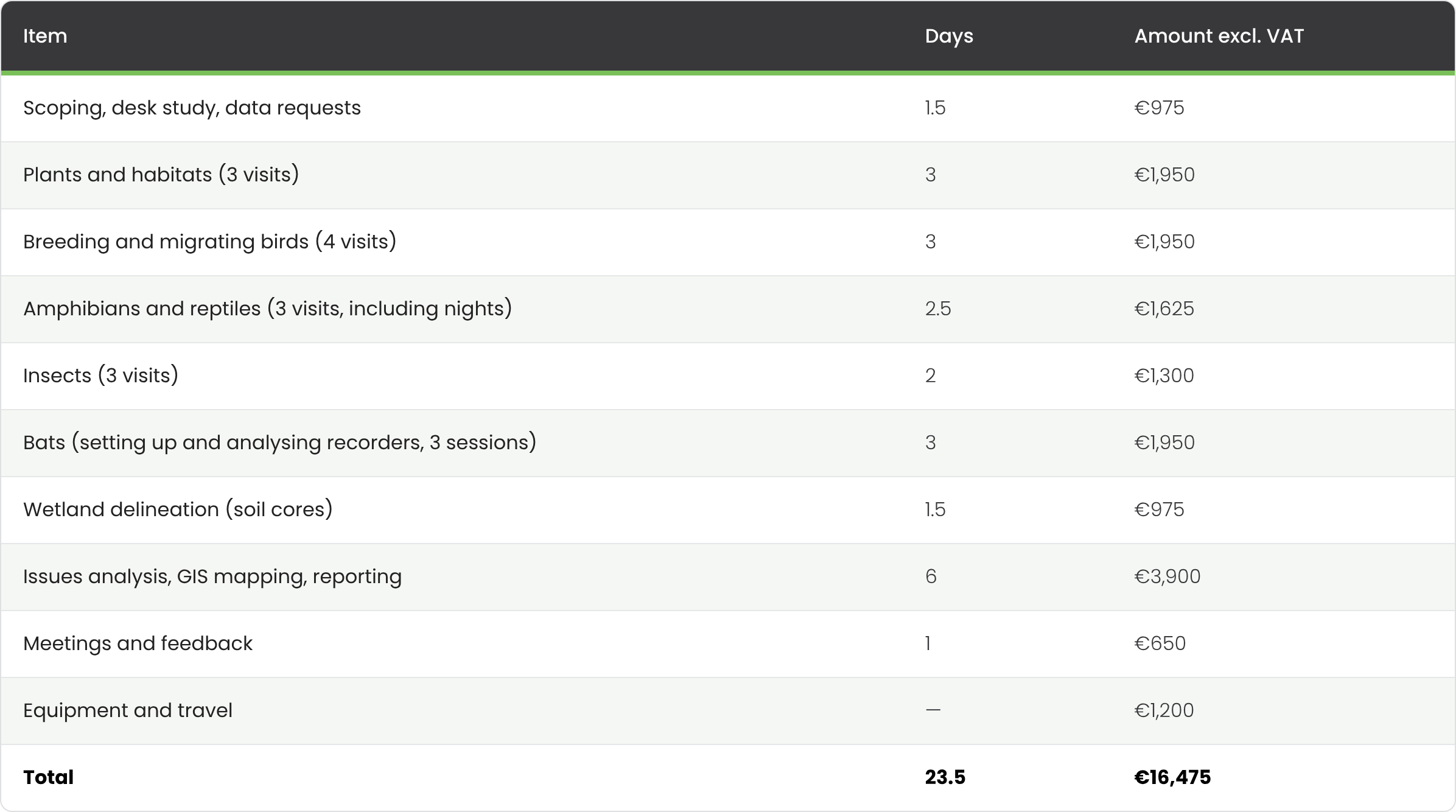
Example of a quote breakdown
Full assessment of an 8-hectare site (meadow, hedgerows, ditch) for a project requiring an EIA. Day rate used as an example: €650 excl. VAT.
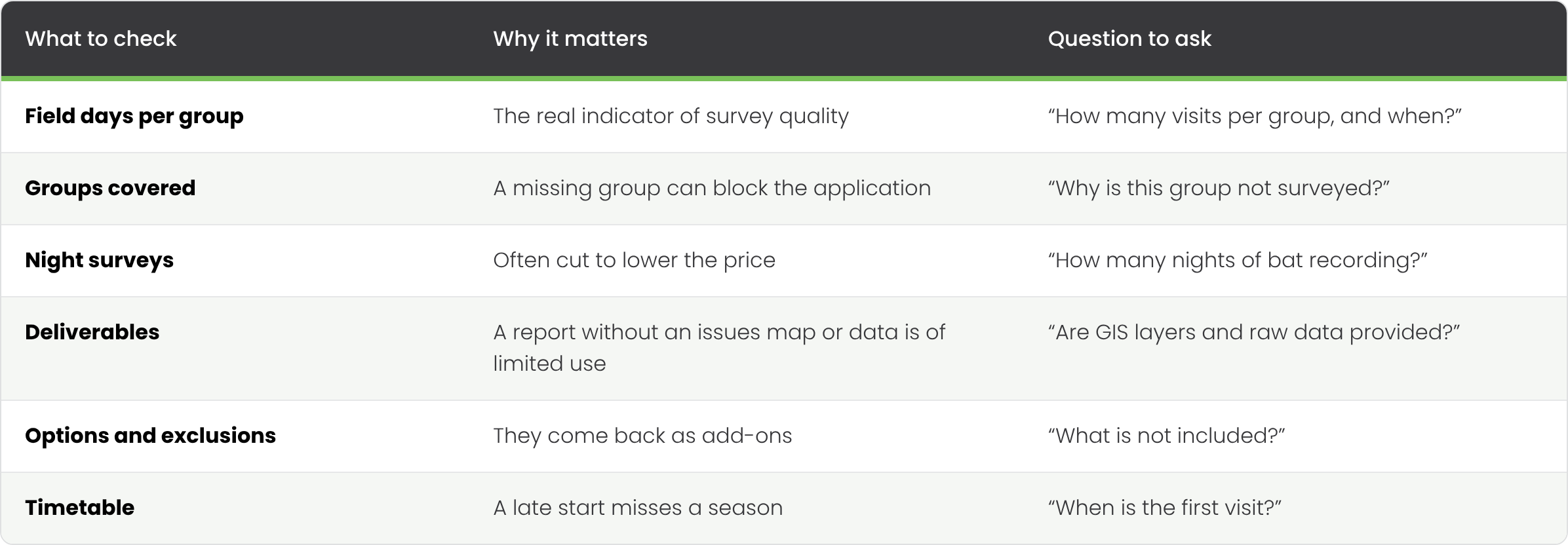
How to compare two quotes
How to control the budget without losing quality
Start with a preliminary assessment: you only pay for the surveys you need.
Prepare the scoping in-house: objective, study area, plans, deadlines, data already available.
Start early: beginning in winter avoids paying for a second year of surveys.
Group your needs: several sites or phases in a single tender.
Require the raw data: it will be reused for monitoring and future studies.
Frequently asked questions
What does a wildlife and plant survey cost?
From a few thousand euros for a preliminary assessment to several tens of thousands of euros for a full year of surveys, depending on area, habitats and groups studied.
What is an ecologist’s day rate?
As an indication, it is often between €500 and €900 excl. VAT per day in a French consultancy, depending on experience, specialism and region.
Why do quotes vary so much?
Because they do not plan the same field effort: number of visits, groups covered, night surveys and deliverables often differ from one offer to another.
Can the cost of four-season surveys be reduced?
It can be optimised by targeting groups after a preliminary assessment and starting early, but cutting the required number of visits risks a request for further information.
Who pays for the ecological study?
The project owner or developer. For voluntary action, some local authorities and companies use public funding, to be checked by region.
Further reading


Take stock of your project
Take stock of your project and the level of study you need. Clear scoping lets you request comparable quotes and pay only for the surveys that matter.