
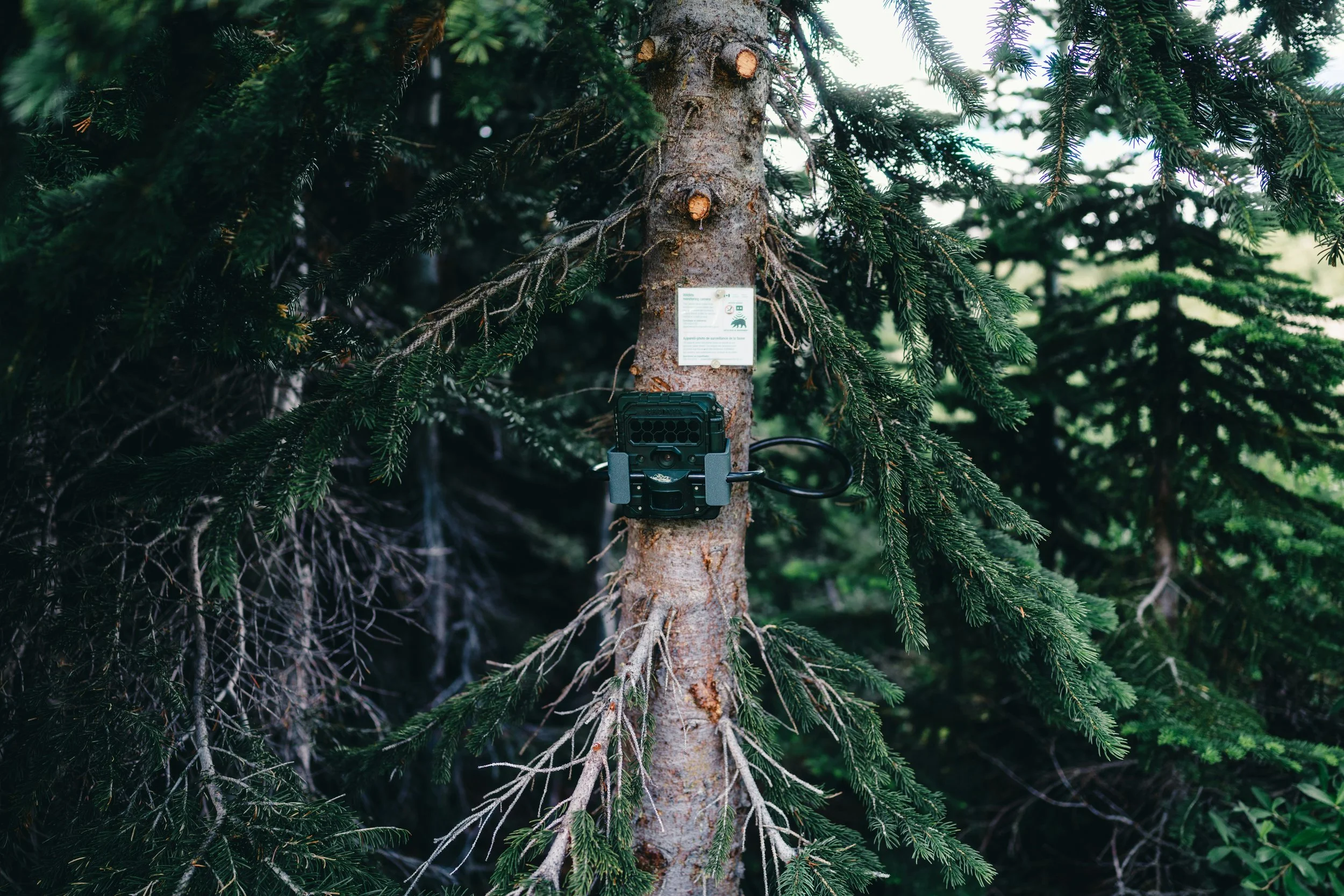
This guide presents practical uses of artificial intelligence for surveying and monitoring a site’s biodiversity, their limits, and the decisions that still require expert validation.
The short answer
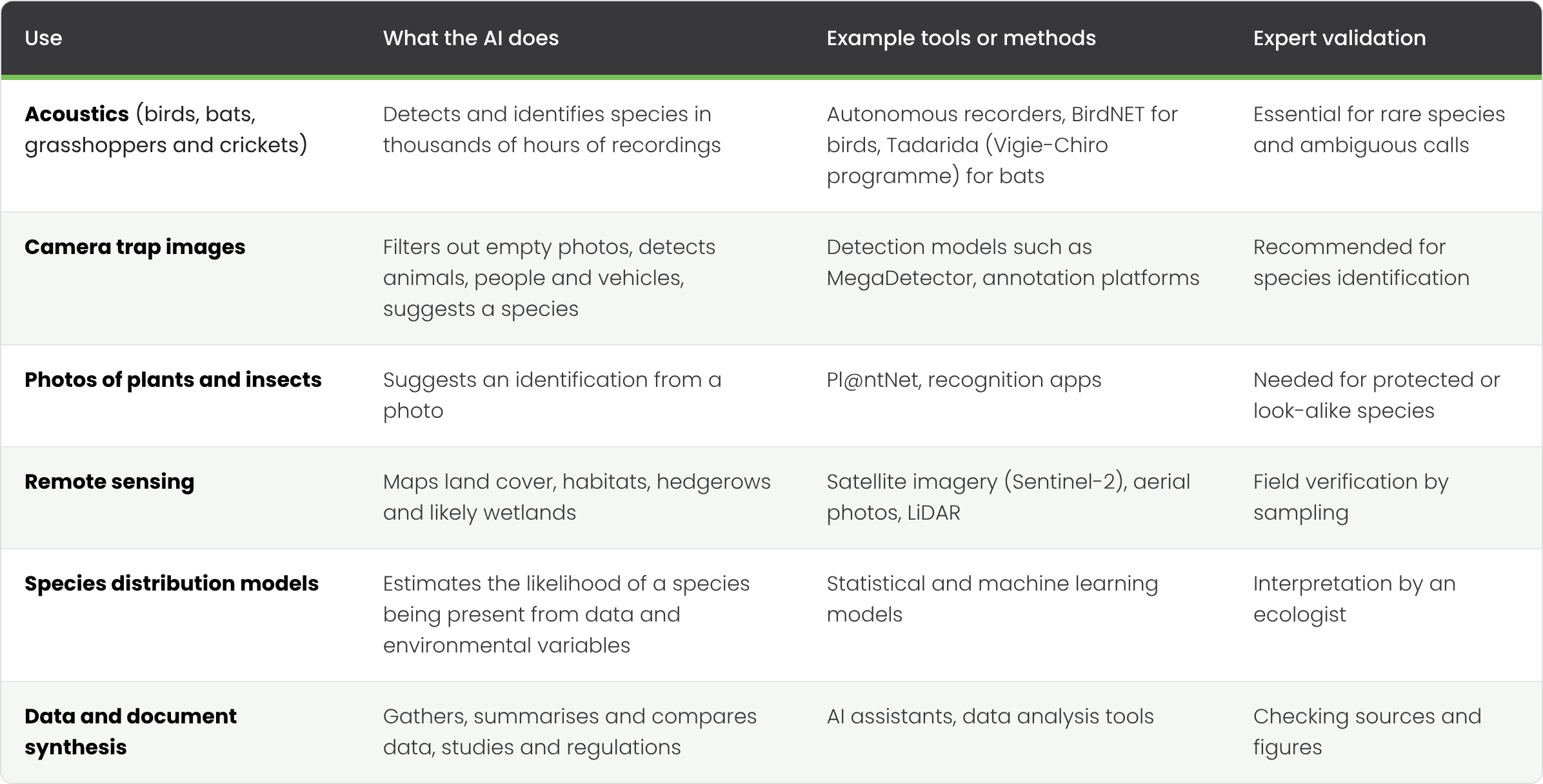
AI is now useful for four tasks: recognising species in sounds (birds, bats, insects) and in images (photos, camera traps), mapping habitats from satellite or aerial imagery, and summarising existing data.
It makes it possible to process large volumes and monitor more often. However, it does not replace the ecologist: identifications of rare or protected species and any regulatory conclusion must be validated by an expert.
At a glance
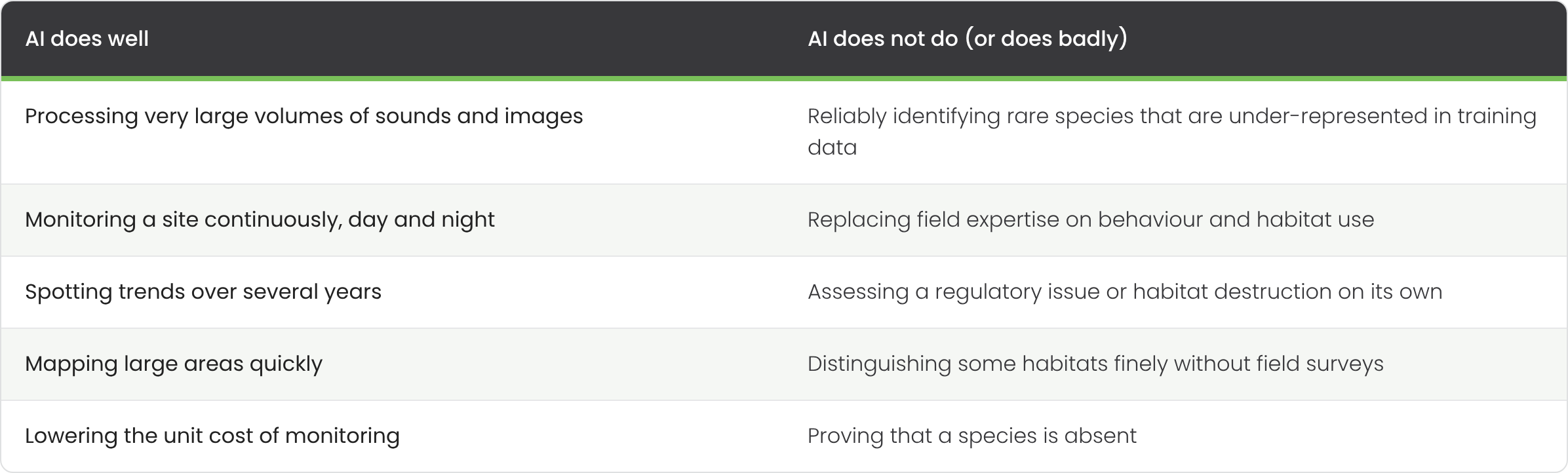
AI speeds up collection and sorting, not ecological interpretation.
Quality depends on training data: rare species and local contexts are often less well recognised.
Every result has a confidence score: set thresholds and check a sample.
Continuous monitoring becomes affordable thanks to autonomous sensors and automated analysis.
Practical uses of AI
What AI does well, and what it does not
Decisions that require expert validation
The presence or absence of a protected species on a site.
The delineation of a wetland in the regulatory sense.
The ranking of issues and the measures to plan for a project.
Any data intended for a regulatory application or public communication.
How to build AI into an assessment or monitoring programme
Start from the question: which species, which habitat, which decision?
Choose the sensor and model suited to the species group and region.
Set confidence thresholds and a verification rule (for example, manual checks of all protected species and 10% of other detections).
Keep the raw data (sounds, images) so it can be reanalysed later.
Have key results validated by an ecologist and document the method.
Worked example: bat monitoring at a wind farm
Need: understand bat activity to adjust how the turbines operate.
Set-up: acoustic recorders running continuously from April to October, automated call analysis.
Role of AI: sort several hundred thousand sequences and suggest a species or species group.
Role of the ecologist: check the sequences of sensitive species, interpret activity in light of weather and season, and propose turbine curtailment rules.
Outcome: more complete monitoring than a few nights of manual listening, with analysis time kept under control.
Frequently asked questions
Can AI replace an ecological survey?
No. It complements the survey by processing large volumes of data, but fieldwork and validation by an ecologist remain necessary.
How reliable is automated species identification?
It is good for common, well-documented species and weaker for rare or similar-looking species. Always consider the confidence score and check a sample.
Can AI-identified data be used in a regulatory application?
Yes, if the method is described and key identifications have been validated by an expert.
Which species groups lend themselves best to AI?
Birds and bats through acoustics, mammals through camera traps, plants through image recognition and habitats through remote sensing.
Does AI reduce the cost of monitoring?
Often, for long-term or large-scale monitoring, because automated analysis cuts the time spent sorting data. Initial investment in sensors and set-up still needs to be planned.
Further reading


Take stock of your project
Take stock of your project and the level of study you need. We help you identify what AI can automate on your site and what should stay in expert hands.