

This guide helps CSR, environment and site managers move from assessment to a practical action plan: priorities, budget, responsibilities and monitoring.
The short answer
A biodiversity action plan is built in six steps: (1) review sites and activities, (2) identify the company’s impacts and dependencies on nature, (3) prioritise the issues, (4) set measurable targets, (5) choose and budget actions, (6) organise monitoring and governance.
Actions on sites (green space management, lighting, habitat features) are often the starting point, but the biggest impacts sometimes lie in the supply chain. A good plan addresses both.
At a glance
Start with the sites you control to achieve quick, visible results.
Look at purchasing and raw materials too: that is often where the major impacts are.
Prioritise: a plan of ten monitored actions is worth more than fifty unfunded ones.
Assign an owner to each action with a budget and a deadline.
Step 1: Review the current situation
Sites: location, area, share of natural space, proximity to sensitive areas (Natura 2000, ZNIEFF, wetlands).
Activities: land take, discharges, lighting, traffic, pesticide use.
Value chain: raw materials, countries of origin, supply chains at risk for biodiversity.
Existing initiatives: certifications, labels, actions already taken.
For priority sites, a biodiversity assessment provides an accurate baseline.
Step 2: Identify impacts and dependencies
A company has impacts on biodiversity (land take, pollution, resource extraction) and depends on services provided by nature (water, pollination, raw materials, climate regulation). Frameworks such as the TNFD LEAP approach or the ENCORE tool help identify them by business sector.
Step 3: Prioritise the issues
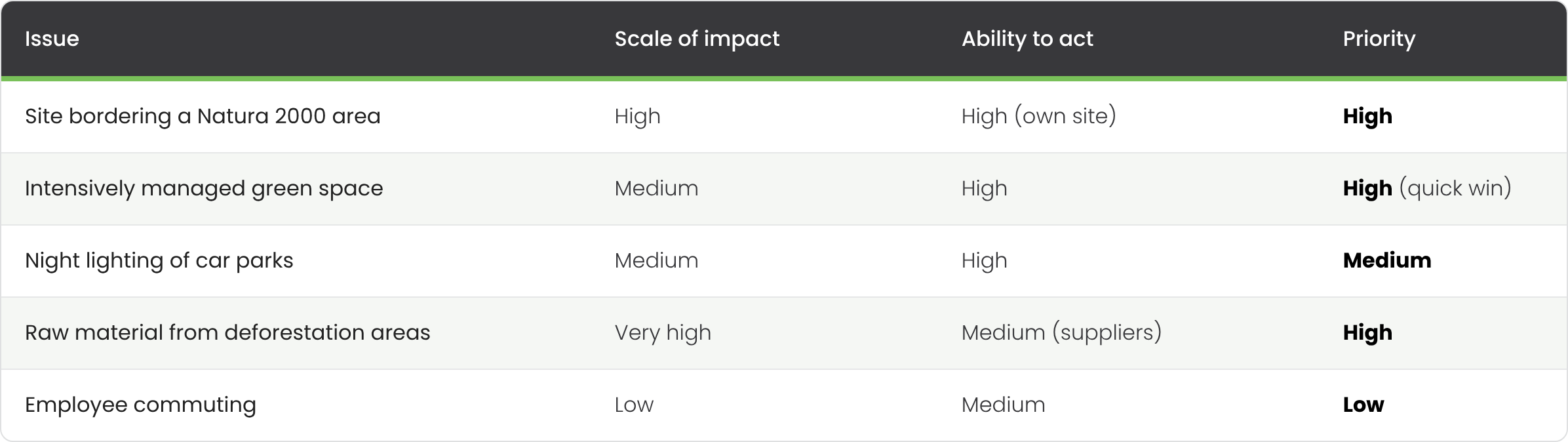
Step 4: Set measurable targets
Each target should be quantified, dated and linked to an indicator. Examples:
Zero pesticides on 100% of sites by the end of 2027.
40% of green space under differentiated management by 2028.
An ecological assessment of 100% of sites within 1 km of a sensitive area by 2028.
100% of at-risk raw material supplies traced and certified by 2030.
Step 5: Choose and budget the actions
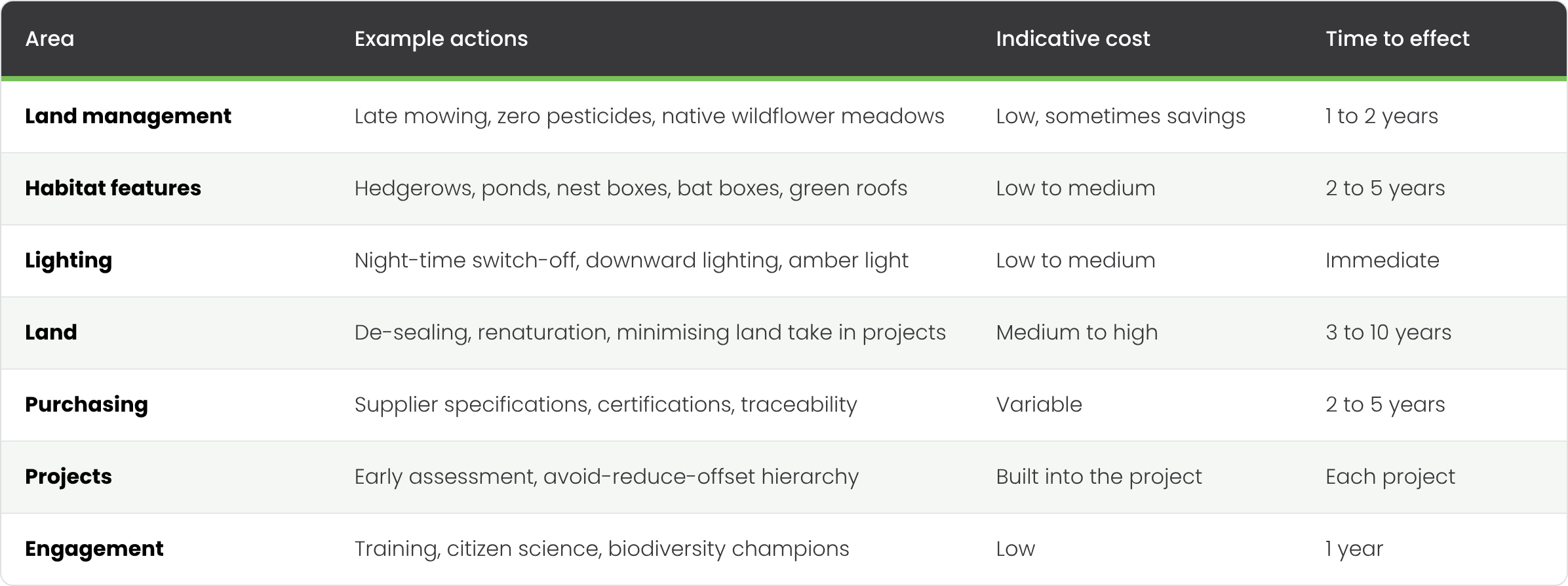
Step 6: Organise monitoring and governance
An executive sponsor and a biodiversity lead who coordinates.
An owner for each action, with a budget and deadline.
A dashboard of a few state, pressure and response indicators, reviewed once a year.
Honest communication: present measured results, not just intentions.
Depending on its size and situation, the company can also report on this plan in its sustainability reporting (ESRS E4 standard for companies within the scope of the CSRD) or in voluntary programmes such as Entreprises engagées pour la nature, led by the French Biodiversity Agency (OFB).
Worked example: a food-processing SME with 3 sites
Review: one site borders a river designated as a ZNIEFF; the main raw material comes from intensive farming.
Priorities: the riverside woodland at the sensitive site, the green space on all three sites, and sourcing.
Actions over 3 years: ecological assessment of the sensitive site and riverbank restoration, differentiated management on all three sites, lights off at night, an “agroecological practices” clause in supplier contracts.
Budget: about €60,000 over three years, half of it for the riverbank restoration.
Monitoring: 5 indicators reviewed each year by the management committee.
Frequently asked questions
Is a company required to have a biodiversity action plan?
Not as such. But companies subject to sustainability reporting must disclose biodiversity information if the topic is material for them, and development projects are subject to the avoid-reduce-offset hierarchy.
Where should a biodiversity action plan start?
With a review of sites and activities, followed by an ecological assessment of the most sensitive sites.
How much does a biodiversity action plan cost?
Management actions (late mowing, zero pesticides, lighting) cost little. Assessments, restoration and work on purchasing make up most of the budget.
What is the difference between impacts and dependencies?
Impacts are the company’s effects on nature; dependencies are the services from nature it needs to operate.
How can greenwashing be avoided?
By setting quantified targets, measuring results and communicating on what has actually been measured, including the difficulties.
Further reading


Take stock of your project
Take stock of your project and the level of study you need. We help you identify your priority sites and move from assessment to a monitored action plan.