

This guide helps project owners, local authorities and companies write a clear specification, compare bids and choose the right provider for an ecological study.
The short answer
To choose an ecological consultancy, start with a specification that sets out the objective, study area, deadline and expected deliverables. Then compare bids on five criteria: ecological expertise for the groups concerned, comparable references, proposed field effort, quality of deliverables and timetable.
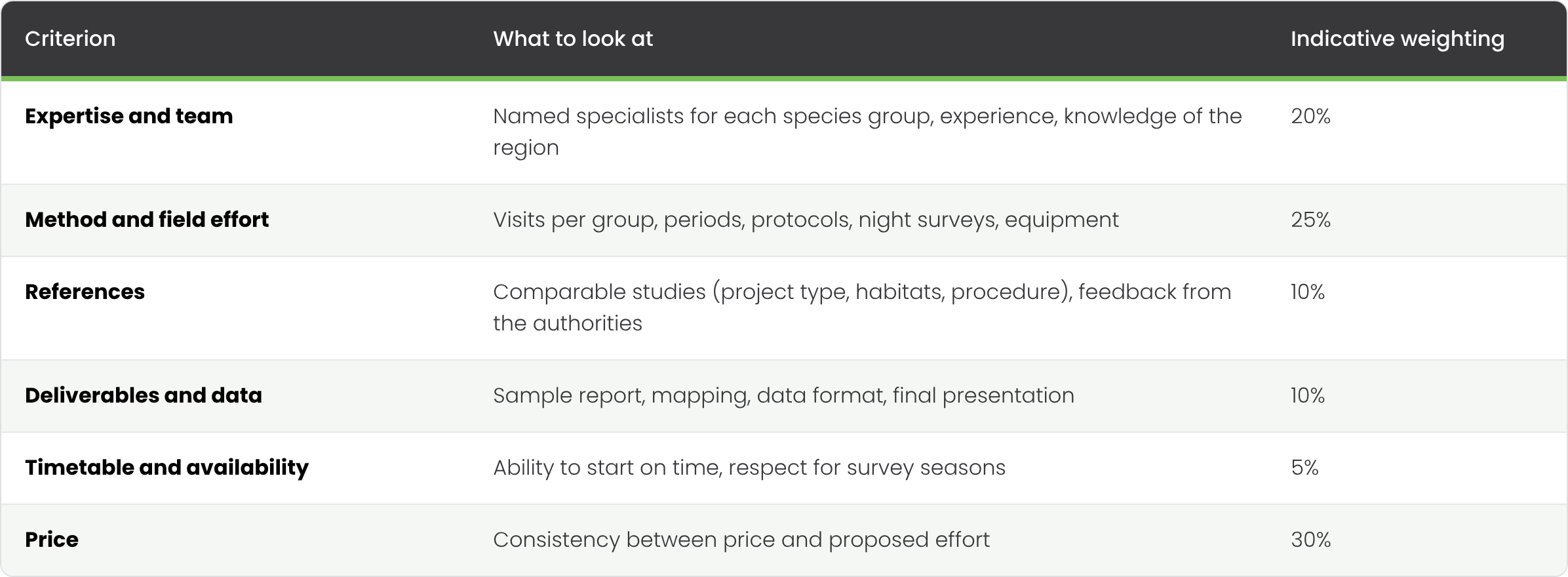
Consult at least three providers and score the bids with a weighted grid. Price should count for no more than 30 to 40% of the score.
At a glance
A good specification makes good bids: without scoping, each consultancy prices a different study.
Check expertise group by group: few firms have in-house specialists for every species group.
Field effort is the best quality indicator, more than the length of the technical proposal.
Require raw data and GIS layers: they belong to you and will be used for monitoring.
Step 1: Write the specification
The specification does not need to be long, but it should contain these elements:
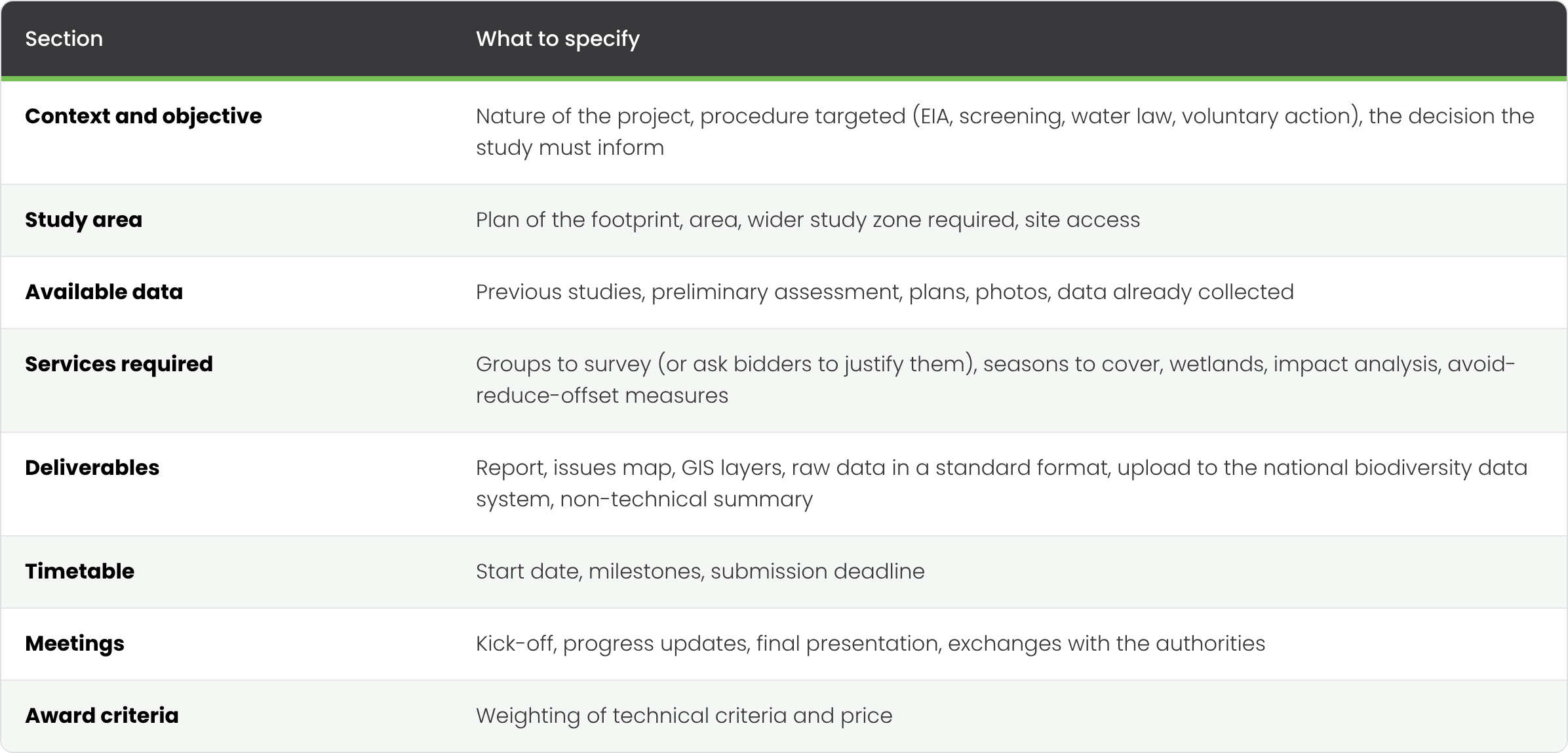
Tip: ask bidders to detail the number of visits per group and per period. This is what makes bids comparable.
Step 2: Criteria for assessing bids
Questions to ask bidders
Who will survey each species group, and with what experience?
How many visits do you plan per group, and on what dates?
Are any services subcontracted (bats, soil science, insects)?
Can you show a report produced for a comparable project?
In what format do you provide data and mapping?
How do you handle the discovery of an unexpected protected species?
Do you hold the necessary permits if capture or handling of protected species is planned?
Warning signs
A price far below the others with no explanation of field effort.
No night visits when the site has hedgerows, trees or water.
Visits concentrated in a single season for a regulatory application.
No named team or unspecified expertise by group.
Data not provided, or provided only as PDF.
Worked example: tender for a 10-hectare project
A group of municipalities consults three consultancies for the extension of a business park.
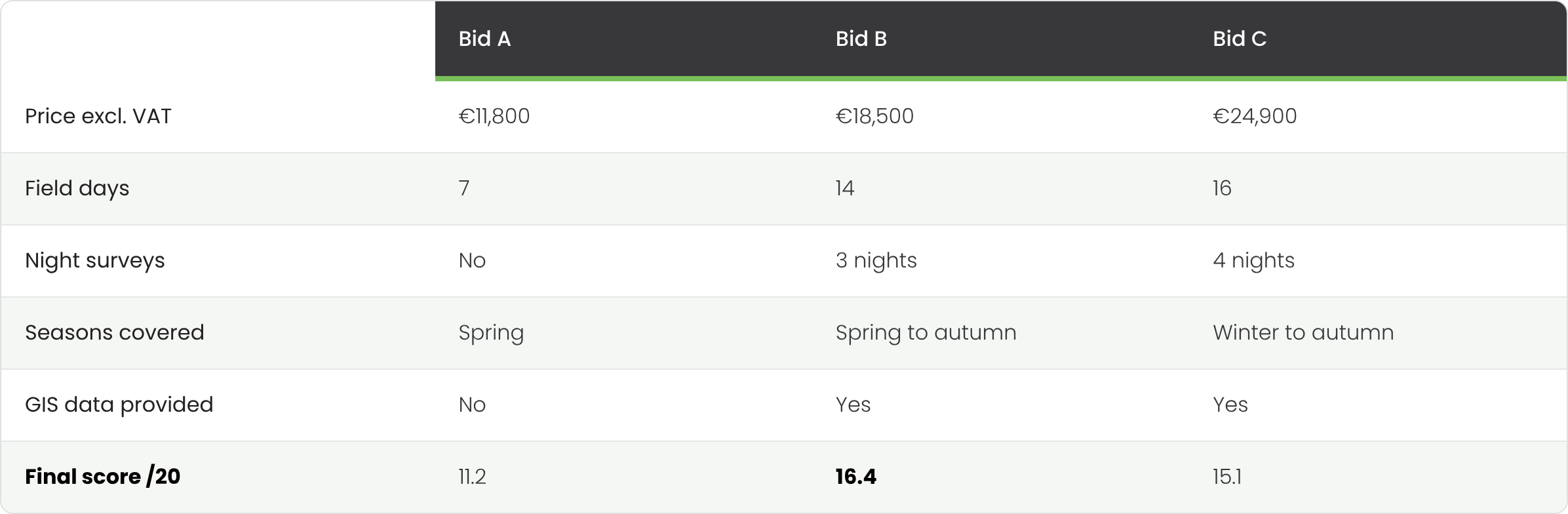
Bid A is the cheapest but covers neither bats nor autumn: it risked a request for further information. Bid B is chosen: it covers the biological cycle at a controlled cost.
Frequently asked questions
How do I find an ecological consultancy?
Through word of mouth from other project owners, professional directories of ecological engineering, references cited in studies published by your regional environmental authority, or an open tender.
How many quotes should I request?
At least three, based on the same specification, so you can compare field effort and price.
Should I choose a local consultancy?
It is not required, but knowledge of the area and proximity reduce travel costs and make it easier to visit on the right dates.
What should an ecological study specification include?
The objective, study area, available data, services and deliverables required, timetable, meetings and award criteria.
Can an independent ecologist replace a consultancy?
For a preliminary assessment or a targeted survey, yes. For a full multi-group assessment, check that they work with the necessary specialists.
Further reading


Take stock of your project
Take stock of your project and the level of study you need before consulting ecological consultancies. A well-scoped need leads to comparable bids.